

PART 3: “Domesticating the Computer“
voidstar and carrioncrow – September 2022

For the detailed background of each item in this mural, see here.
Quick highlights:
- The dark-blue to light-blue background color depicts a kind of “deep ocean” to “sky” (portable) transition. Similar to the progression of dinosaurs: initially very large creatures, and then gradually to very small.
- The gray background at top/bottom has some texture to represent refined silicon sand, used to make microprocessors.
- The two men on the far left center are Ken Thompson and Dennis Ritchie (the developers of Unix and C)
- The bottom row of systems is the “Intel Row,” then Apple/PET to C64 is the “Commodore Row,” followed by the Zilog systems at top (TRS-80 to ColecoVision).
- The “single boards” depicted in 1976 intentionally represents that “turning point” moment that made mass production of systems possible. Prior to this, most computer systems were under 10,000 units sold (customers interacted directly with the manufacturers). Between 1976 and 1980, those systems were 20k to 100k units sold (and began to appear in “Computer Stores”). The IBM PC in 1981 was the first to reach 1,000,000 units sold.
One day, my daughter and I were debating about what was the “first personal computer.” Over the years, I’ve also discussed this with folks several decades older than myself, and I’ve realized that each generation has a different perspective about the definition of “personal computer.” (example)
There are many fine articles, publications, and websites that cover all-aspects of computer history. But as I began discussing the variety of systems with my daughter, I found there was no singular quick overview to show the highlights of the progression between early personal computers and what eventually became welcomed-appliances into homes: not just by having a nice cabinet (case), but by also actually being useful to both technical and non-technical users.
The mural above is part three of what is planned as a four-part series. It is meant primarily to motivate discussions and is not a definitive answer to any “first” or “priority.” But it is an overview of that story of what I call “domesticating the computer.“
In one of the halls of the Vatican Museum, they have a row of centuries old tapestries. If one were to ever weave a tapestry of the story of the origins of home computing, I imagine it would look something like this mural.
Highlights of the other sections is drafted as follows:
PART 1: 1940-1954 ENIAC (Colossus ABC)
PART 2: 1955-1969 IBM 610, IBM 1401, PDP-1, UNIVAC 422, IBM System/360
PART 3: 1970-1984 PDP-11, Alto, Trinity PCs, IBM PC, C64, Macintosh (domesticating the computer)
PART 4: 1985-1999 Compaq DeskPro 286, PS/2, Apple PowerBook, 386/486/Pentium, EGA/VGA, ethernet
EXTENDED
PART 5: 2000-2014 multi-core, 64-bit, 802.11b/g/n, Raspberry Pi, GPU, HD/4K, mSATA/M.2, tablets
PART 6: 2015-2029 PCIe 4, 802.11ac, 8K, Threadripper, VR, “nanocomputers”
There were many “first” along the way, from both grass-roots lone engineers and corporate engineering teams. But this was “pre-Internet” and ideas did not pass around the globe, or even across coasts, as quickly as they do today. So, it may be difficult to fairly establish the priority of who-influenced-who. The items within the mural are roughly time-aligned to the major release of products. Each image has a deep back-story as to what was involved in their respective development. And now with the passage of time, we can reflect upon this history, be inspired by the incredible ingenuity that it involved and recognize this pivotal change in humanity: the combination of hardware and software to create never-before imagined systems.
The development of the microprocessor is as pivotal as the Gutenberg Press of 1450 AD in terms of significantly reducing the cost and time for spreading information and ideas. The press, like the microprocessor, is clever hardware – but it is the content-creators that used this hardware to make huge impacts to the world.
Honorary mentions: We would have liked to included the following on the poster…
- Mark-8 (1974): This was an Intel 8008 based multi-board kit that prompted the later publication of the famous Altair 8800 (and also motivated the Digital Group personal computer). See HERE
- Sphere-1 (1975): Motorola 6800 based system. Could not cost-compete against the 6502, and not enough developers and traction to go mainstream.
- IMASI 8080 (1975): A clone of the Altair 8800, leading to the VDP-40 (1977) “desktop computer” that was still over $7000 (but with two 5.25″ disk drives). An IMASI 8080 was the equipment used to run the first BBS.
- Atari 2600 (1977): MOS 6507 base system (cheaper than 6502 due to 13 instead of 16 address-pins).
- TI-99/4 (1979): Texas Instruments was the largest semiconductor manufacturer in the world and had significant business for both large minicomputers and scientific calculators. TI competed against Intel in 1972 in a contract to build (for CTC) what effectively became the 8008 microprocessor. But the TI’s solution was twice the size and ended up never used. TI came late to the microcomputer scene (partly due to FCC regulation changes related to connecting computers to television sets, a similar issue that forced Tandy to discontinue the TRS-80 Model 1), however TI did produce the first 16-bit home microcomputer (based on the TMS9900 CPU). Unfortunately, TI did not gain a critical mass of developer support for yet-another processor instruction set (since they kept technical information proprietary and could not cost-compete against competitors). If the TI-99/4 were included, it would go below where the Apple Graphics Tablet is located.
- Sun-1 (1982): First Unix workstation, using Motorola 68000 (probably what the Sphere-1 would have become!). I didn’t include the Sun-1 since I considered it more of an office computer rather than a home computer. That’s a “gray area” since some high-tier engineers probably could afford the Sun-1 at home (recall DEC initially charged something like $20k just for the Unix OS, which some say is what allowed Microsoft to become successful by offering a less expensive alternative). But secondly, the Sun-1 would be right where AutoCAD and Flight Simulator appear, and I felt it important to include a sample of early productivity software available on microcomputers. It may be possible to move those two software titles down and make room for Sun-1 where AutoCAD is at.
- Sinclair ZX Spectrum (1982): Being a Z80 based system with lots of existing developer support, and at a reasonable cost-point, the Sinclair ZX Spectrum became a very successful system in the UK. If placed on the mural, this system would sit right where the ColecoVision is placed. I decided to include the ColecoVision because by 1983, it had unit sales in the millions (compared to Spectrum roughly 300k units by then — which is certainly still “successful” category, and the line continued to be sold till the early 1990s). Also because the ColecoVision had the feature of being expandable into a computer, which is an interesting discussion point. The other complication is that ZX Spectrum is preceded by the ZX81 (1981), ZX80 (1980), and MK14 (1977 kit). If I were to place this on the mural, I’d pick the ZX81 and it would go in-between the TRS-80 Model 3 and the OSBORNE (the prior ZX80 used a different NEC based CPU). Or, since the TRS-80 Model 3 was used more in schools than homes (since the Color Computer became Tandy’s home computer offering at that time), in hindsight I agree the TRS-80 Model 3 could be replaced by the ZX80.
- Compaq Portable (1983): First MS-DOS 8088 based “luggable” PC (Compaq successfully reverse-engineers IBM PC BIOS); IBM subsequently came out with their IBM Portable PC in 1984, followed by the more compact (NiCd-powered) IBM PC Convertible in 1986.
- IBM PC AT 5170 (1984): IBM updates their PC line with Intel 80286 processor, officially entering the 16-bit era. Some argue that it was not until this time that microcomputers began to match the performance of prior minicomputers.
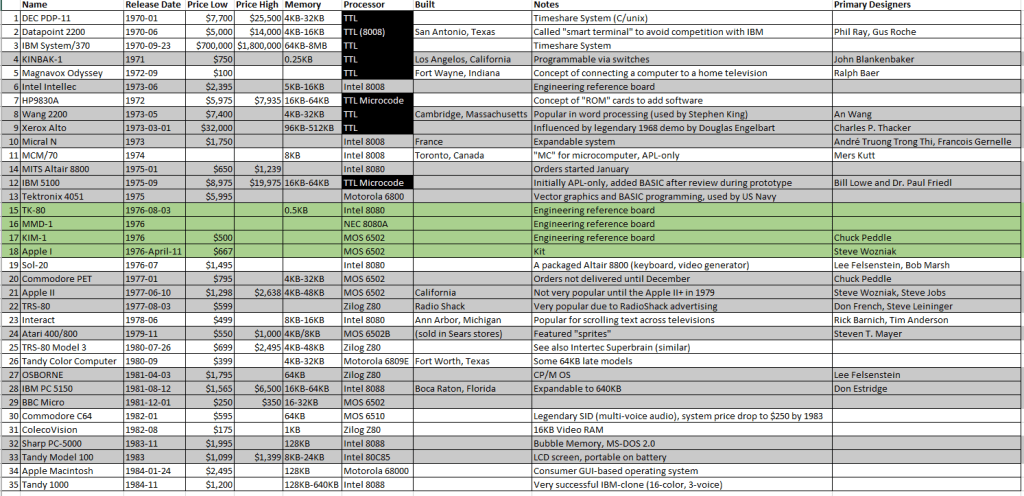
This mural includes 35 computer systems, 16 software titles, and three peripherals arranged in “time columns” corresponding to the approximate year of that products release. Each item has a story to tell on how it was developed and what ideas it influenced thereafter. This is by no means a comprehensive catalog but was limited in scope only due to the practical desire of fitting within a standard 2D page of information (while using a reasonable font size!).
The following charts itemize the products that are represented in the poster:
(click on images for larger preview)

Thank you for joining us on reflecting upon this history. If “you were there” during that time and have any stories or reflections to share, by all means please share a comment below. Or any other stories or feedback are also certainly welcomed! Perhaps we’ll make a similar poster for the decades prior and after, let us know if interested in that.
Full resolution download is available here.
Other Computing History resources
Computer History (computerhope.com)
Steve’s Computer Collection (oldcomputers.net)
Welcome | Timeline of Computer History | Computer History Museum
The Texas Instruments TMX 1795: the (almost) first, forgotten microprocessor (righto.com)